

Assessing a teenager isn’t the same as assessing a young child, and it shouldn’t be. By the time your child reaches high school, they’ve usually developed their own ways of managing schoolwork, friendships, and other people’s expectations, which means differences that were obvious at five can be much harder to spot at fifteen. If you’re a Melbourne parent wondering whether an assessment for your adolescent could help explain a recent change in grades, mood, or motivation, it helps to understand what actually changes about the assessment process once your child becomes a teenager, not just whether they need one.
Why the Teenage Years Change the Picture
Younger children are mostly assessed through parent and teacher input, with the child observed rather than interviewed at length. Adolescents are different. A teenager is old enough to describe their own experience of school, friendships, and their own thinking, so a direct clinical interview with your teen becomes a central part of the process, alongside standardised testing and input from parents and teachers.
At Raise the Bar Clinic, our school-age and adolescent assessment packages reflect this shift, and are delivered using a hybrid model: most conversations happen via telehealth from home, with only the essential face-to-face testing held in person at one of our clinics. This tends to suit teenagers, who are often more comfortable speaking candidly from their own space than in a clinic room.
When Autism or ADHD Wasn’t Picked Up Earlier
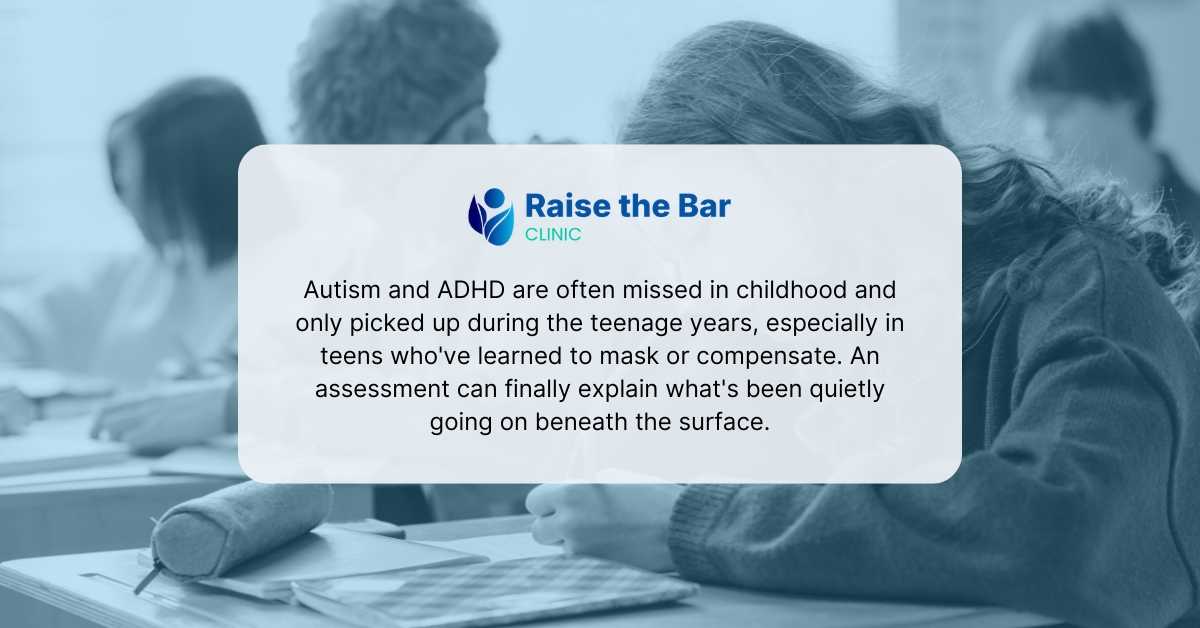
It’s common for autism or ADHD to be missed in childhood and only become clear during adolescence, particularly for teenagers who have learned to compensate. A bright, verbal teenager might mask social differences by scripting conversations or closely observing peers, or an inattentive teenager might have coasted through primary school on natural ability before executive functioning demands caught up with them in high school. This is part of why searches for a teenage autism test or a psychologist for teenager autism in Melbourne tend to increase once a child reaches secondary school, even when nothing was flagged earlier.
An adolescent ADHD assessment looks at attention, impulsivity, and organisational skills across school, home, and social settings, drawing on behaviour rating scales from parents and teachers alongside a clinical interview and observation of your teen. Many families come to us searching for a teen ADHD assessment near me once the jump to high school, or the lead-up to VCE, starts to outpace their current coping strategies. An autism assessment for a teenager follows a similar combination of standardised testing, direct conversation, and third-party input, and can include a cognitive assessment where useful.
The Exam Season Factor: Cognitive Assessments and Special Provisions
A cognitive assessment for an adolescent looks at language, reasoning, visual processing, memory, and processing speed, the skills that sit underneath academic performance. For Victorian students, this type of assessment carries a practical benefit that doesn’t apply to younger children: it can support applications for special provisions during VCE and International Baccalaureate (IB) end-of-school exams, such as extra time, rest breaks, or use of a laptop or assistive technology. Where reading, writing, or maths concerns are present alongside attention or cognitive differences, a learning assessment can clarify whether a specific learning disorder, such as dyslexia, dysgraphia, or dyscalculia, is contributing to the picture, and inform what accommodations might help both in the classroom and in exam conditions.
Looking Ahead: Vocational and Career Planning
Adolescence is also the stage where families start asking a different kind of question, not just what’s going on, but what comes next. Adolescent assessments look at your teenager’s transferable skills, interests, and aptitudes to help identify study, training, or career pathways that suit them, and can be particularly useful for older teens weighing up subject selection or post-school options, including teens on the NDIS considering employment or further training with the right supports in place. This is offered as part of our assessment services at Raise the Bar Clinic.
What Actually Happens During an Assessment
The exact process depends on what’s being assessed, but a few things stay consistent across most adolescent assessments:
- An initial conversation to understand your concerns and match your teen with the right assessment type
- A clinical interview with your teen themselves, not just with parents
- A combination of telehealth and in-clinic sessions, depending on what’s being assessed
- A feedback session and comprehensive written report, generally provided around four weeks after the final assessment session
- Access to ongoing support afterwards, including parent coaching, school consultation or counselling, if useful
For a full breakdown of assessment inclusions and pricing, see our assessment packages page.
Is an Assessment the Right Step Right Now?
Not every concern needs a formal assessment straight away. If something has only just started, or seems tied to a specific event such as a change of school or a particularly hard term, it can be worth giving things a little time and checking in with teachers first. An assessment tends to be most useful once a pattern has been present for a while and is affecting more than one part of your teenager’s life, whether that’s school, friendships, or how they’re feeling day to day.
If you’re not sure whether now is the right time, a discovery call is a free, no-pressure way to talk through what you’re noticing and figure out the best next step together.
Common Questions About Assessments for Adolescents
Will my teenager be interviewed on their own?
Yes, in most cases. A direct conversation with your teen is a standard part of an adolescent assessment, alongside input from parents and teachers, since your teen is old enough to describe their own experience.
Do I need a referral for an assessment?
No referral is needed. Our team can help you work out which assessment would be most useful based on your teenager’s needs.
Can I get a Medicare rebate?
Medicare rebates may be available if your teen is referred under items for complex neurodevelopmental disorders and eligible disabilities by a paediatrician or psychiatrist.
Can assessment results be used for NDIS or school funding applications?
When appropriate, a comprehensive report can support NDIS applications, disability inclusion funding, individual education plans (IEPs), and applications for exam special provisions such as during VCE and IB.
What if my teenager is reluctant to be assessed?
This is common, and our team is experienced in helping teenagers feel comfortable with the process. A discovery call can also be a useful first step to talk through any hesitation before booking a full assessment.
Adolescent Psychological Assessment: Your Questions Answered
| Question | Answer |
|---|---|
| Will my teenager be interviewed on their own? | Yes, in most cases. A direct conversation with your teen is a standard part of an adolescent assessment, alongside input from parents and teachers, since your teen is old enough to describe their own experience. |
| Do I need a referral for an assessment? | No referral is needed. Our team can help you work out which assessment would be most useful based on your teenager’s needs. |
| Can I get a Medicare rebate? | Medicare rebates may be available if your teen is referred under items for complex neurodevelopmental disorders and eligible disabilities by a paediatrician or psychiatrist. |
| Can assessment results be used for NDIS or school funding applications? | When appropriate, a comprehensive report can support NDIS applications, inclusive education funding, individualised education plans, and applications for exam special provisions such as VCE. |
| What if my teenager is reluctant to be assessed? | This is common, and our team is experienced in helping teenagers feel comfortable with the process. A discovery call can also be a useful first step to talk through any hesitation before booking a full assessment. |
Final Thoughts
The teenage years bring a different set of questions than early childhood does, from masked differences finally surfacing to decisions about exams, study, and what comes after school. An assessment built around where your teenager actually is, not a generic checklist, is what makes the results genuinely useful for the years ahead.
If you’d like to talk through your teenager’s needs, book a discovery call with our team. We’re here to help you find the right assessment pathway for your teen.